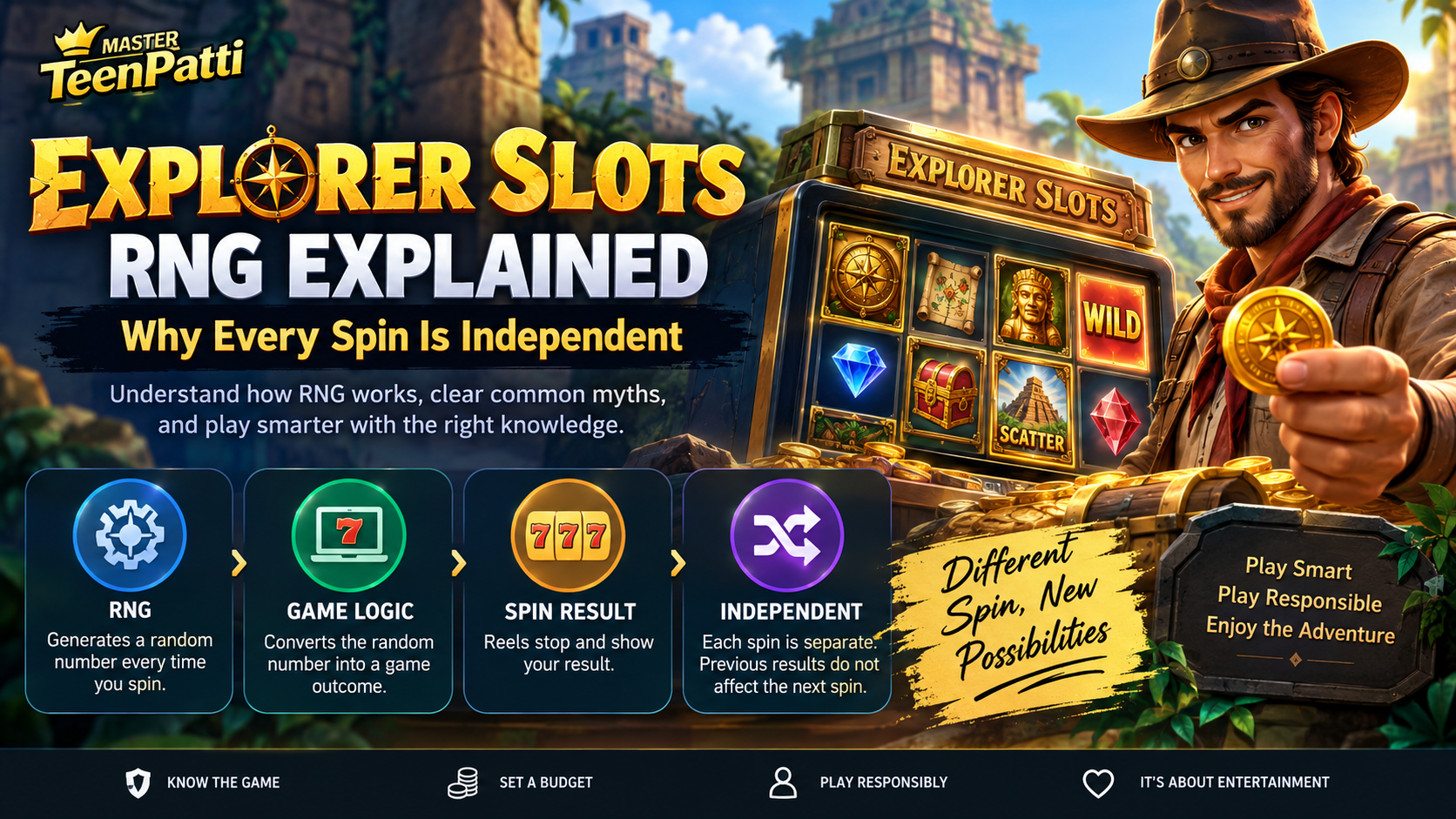
When playing Explorer Slots, many players wonder whether previous spins affect the next result. A common question is simple: If several spins lose in a row, does the next spin become more likely to win?
The answer depends on how the game's Random Number Generator (RNG) works.
An RNG is a software system designed to produce unpredictable numerical results. In a properly designed slot system, the RNG determines the outcome according to the game's mathematical rules. Previous wins or losses should not make the next spin “due” for a particular result.
👉 Download Now and Claim a welcome bonus → mymasterteenpatti.com
This guide explains Explorer Slots RNG, how independent spins work, what RNG means for players, and why chasing previous results can create misleading expectations.
Important: RNG does not guarantee a win or a fixed return from a short session. It only helps determine outcomes according to the game's programmed rules and probabilities.
What Is RNG in Explorer Slots?
RNG stands for Random Number Generator.
In a digital slot game, an RNG generates numerical values that the game can map to possible outcomes. The exact implementation can vary between games and gaming systems.
For regulated gaming systems, technical standards commonly require RNG outputs to demonstrate properties such as randomness, unpredictability, appropriate distribution, and independence. The UK Gambling Commission, for example, states that random outcomes should be demonstrably random and unpredictable through accepted statistical testing.
In simple terms:
RNG → Random value → Game outcome → Reel result
The reels and animations provide the visual experience, while the underlying game mathematics determines the result.
Why Is Every Spin Independent?
The key concept behind RNG-based slots is independence.
If one spin produces a losing result, that does not automatically make the following spin more likely to win. Similarly, a winning spin does not automatically make the next spin more likely to lose.
Gaming Laboratories International's technical standards describe independence as a situation where knowledge of one draw does not provide information about the number or outcome selected in a future draw.
A Simple Example
Imagine these five spins:
- Spin 1: Loss
- Spin 2: Loss
- Spin 3: Win
- Spin 4: Loss
- Spin 5: Loss
A player might think:
“Four losses happened recently, so a win must be coming.”
That conclusion does not follow from independent random outcomes.
The next spin does not need to compensate for previous losses. It follows the game's programmed probability and outcome rules.
Does a Losing Streak Change the Next Spin?
No, not simply because a losing streak occurred.
A sequence such as:
Loss → Loss → Loss → Loss
does not create a mathematical obligation for:
Win
on the next spin.
This is one of the most important concepts to understand when playing any RNG-based slot game.
A previous outcome may feel important because humans naturally look for patterns. However, random sequences can contain clusters, repeated results, and unusual streaks without becoming predictable.
Does a Winning Streak Mean the Game Is “Hot”?
Not necessarily.
Players sometimes describe a slot as “hot” when it produces several wins close together. Others may call it “cold” after multiple losses.
These labels can describe what a player has observed, but they do not prove that the next outcome will follow the same pattern.
A short sequence does not tell you what the next independent outcome will be.
That is why responsible players should avoid increasing their spending simply because a game appears to be “hot” or chasing losses because they believe a game is “cold.”
RNG and RTP Are Not the Same
Another important distinction is between RNG and RTP.
RNG
RNG determines or helps determine individual random outcomes according to the game's design.
RTP
Return to Player (RTP) is a long-term theoretical percentage used to describe how much a game is designed to return over a very large number of plays.
For example, an RTP figure of 96% does not mean that a player will receive $96 back after spending $100 in one session.
Short-term results can vary significantly.
Therefore:
RNG explains individual outcomes, while RTP describes a long-term mathematical expectation.
Players should always check the official game information for the applicable RTP rather than assuming a percentage.
Can You Predict the Next Explorer Slots Spin?
No reliable strategy can predict an individual RNG outcome simply by studying previous spins.
You may see patterns on the screen, but a pattern does not automatically provide predictive information.
Technical RNG standards also focus on unpredictability and statistical independence. For example, UK Gambling Commission guidance says software RNG outputs should be difficult to predict without complete knowledge of the relevant algorithm and seed information.
This makes ideas such as these unreliable:
- “The machine is due to pay.”
- “Five losses mean a win is coming.”
- “A recent jackpot means another jackpot is unlikely.”
- “Stopping the reels at the right moment changes the result.”
- “Playing at a particular time guarantees better results.”
Why Understanding RNG Matters
Understanding RNG helps players make better decisions.
Instead of trying to predict the next result, focus on:
- Understanding the game's rules
- Checking available game information
- Setting a spending limit
- Treating results as random
- Avoiding loss chasing
- Taking breaks
- Playing only with money you can afford to lose
RNG knowledge cannot improve the probability of a particular spin, but it can help prevent common misconceptions.
Final Takeaway
Explorer Slots Game Tricks RNG is important because it explains why individual spins should be treated as independent random events. A previous loss does not make a win due, and a previous win does not automatically make a loss more likely.
The best approach is to understand the game's rules, avoid prediction myths, set clear limits, and treat slot play as entertainment rather than a guaranteed way to make money.
For technical context, established gaming standards emphasize randomness, unpredictability, statistical testing, and independence between outcomes.
Sources & Further Reading
- UK Gambling Commission – RTS 7: Generation of Random Outcomes: Requirements covering randomness, unpredictability, distribution, and independence.
- Gaming Laboratories International – GLI-11: Technical standards covering RNG independence, statistical testing, and available outcomes.
- U.S. e-CFR – Electronic Random Number Generation: Technical requirements covering independence, unpredictability, non-repeatability, and statistical testing.
Frequently Asked Questions About Explorer Slots RNG
Is Explorer Slots based on RNG?
Explorer Slots is presented as a digital slot-style game. However, players should check the specific game's official information for details about its RNG implementation and certification. This article does not independently certify the game's RNG.
Does every Explorer Slots spin have the same result probability?
Not necessarily every symbol has the same probability. A game's mathematical design can assign different probabilities to different outcomes. What matters is that the RNG and outcome mapping follow the stated game rules and applicable technical requirements.
Can previous Explorer Slots spins predict the next spin?
No. Previous results should not be treated as a reliable prediction of the next independent RNG outcome.
Does a losing streak mean a win is coming?
No. A losing streak does not automatically create a guaranteed winning spin.
Can players control an RNG result by stopping the reels?
In an RNG-based slot, visual reel stopping should not be confused with controlling the underlying random outcome. The exact mechanics depend on the specific game implementation.
Is RNG the same as RTP?
No. RNG concerns random outcome generation, while RTP represents a game's long-term theoretical return.
Is Explorer Slots guaranteed to produce a profit?
No. RNG-based games involve chance, and individual sessions can produce losses or wins. Players should never treat a slot game as a guaranteed source of income.