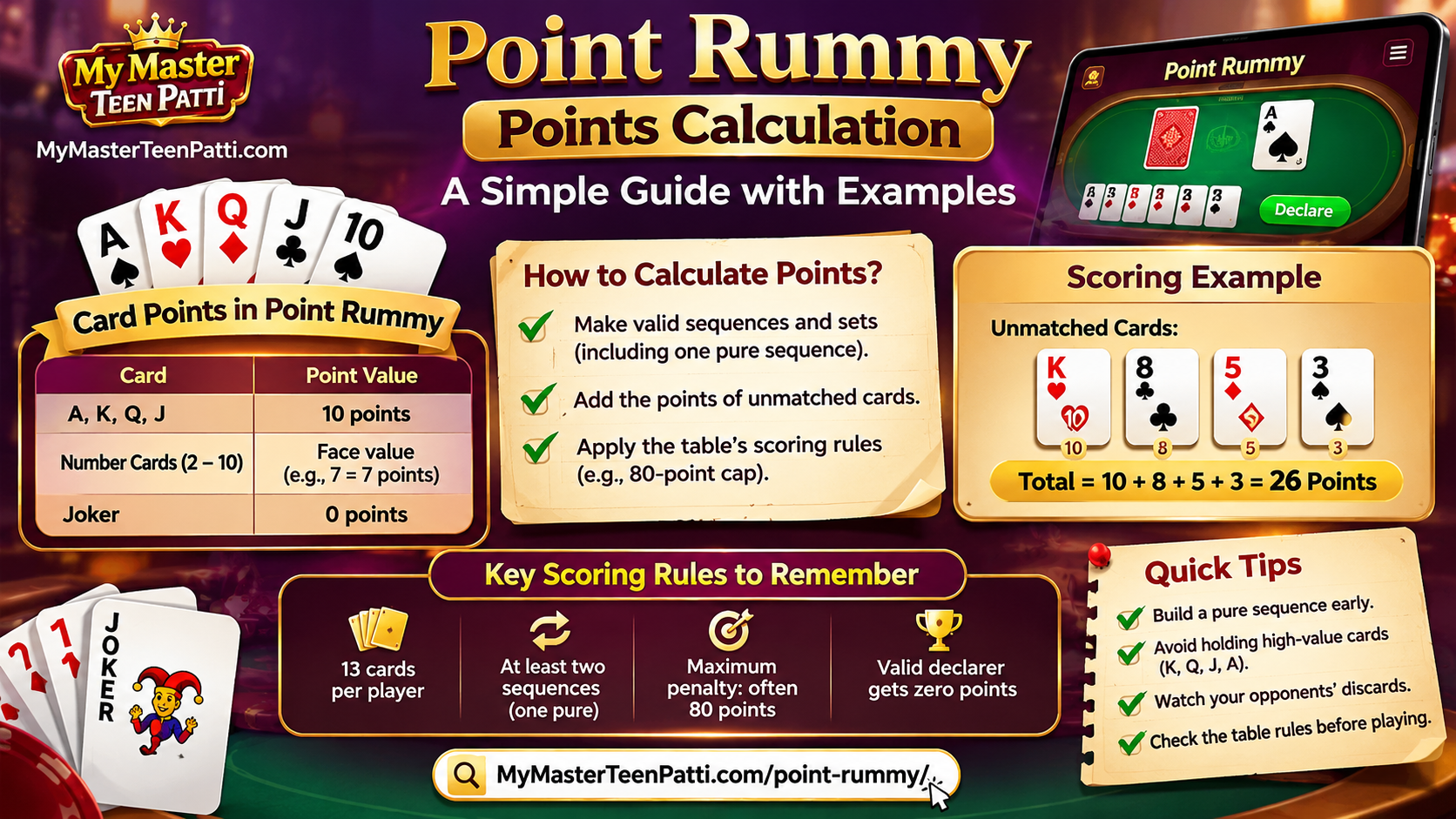
Understanding card values and scoring rules can help beginners make better decisions during a rummy game. When you know how each card contributes to your score, you can manage your hand more carefully and understand the result of each round.
A point rummy app makes it easier to follow card combinations, track scores, and learn the rules through gameplay. Before joining any table, understand the point value, penalty rules, and terms displayed by the platform. These details matter because different rummy variants and apps may apply specific scoring limits.
What Is Point Rummy?
Point Rummy is a 13-card rummy format in which players compete to make valid sequences and sets. The round usually ends when a player makes a valid declaration. Other players then receive penalty points based on their unmatched cards and the game's rules.
Each point has a predetermined monetary value at cash tables. However, the value of a point does not guarantee a profit. Your final result depends on the game outcome, applicable fees, and the platform's terms.
Point Rummy Card Values Explained
In a typical Indian 13-card Point Rummy game, each card has a specific value for scoring.
| Card | Point value |
|---|---|
| Ace (A) | 10 points |
| King (K) | 10 points |
| Queen (Q) | 10 points |
| Jack (J) | 10 points |
| Number cards (2–10) | Face value |
| Joker | Usually 0 points |
For example, a 7 carries seven points, while a King carries ten points. Jokers generally carry zero points, but you should always check the rules of the selected table.
How to Calculate Point Rummy Scores
Follow these steps to understand the scoring process.
Step 1: Identify Valid Sequences and Sets
Arrange your cards into valid combinations. A sequence contains at least three consecutive cards of the same suit. A pure sequence does not use a joker as a substitute.
A set contains three or four cards of the same rank in different suits. A valid declaration generally requires at least two sequences, including one pure sequence.
Step 2: Add the Points of Unmatched Cards
After an opponent makes a valid declaration, count the points of your cards that do not belong to valid combinations. Cards in valid sequences and sets generally do not add to your penalty score.
Step 3: Apply the Table's Scoring Rules
Many Indian Point Rummy formats cap a player's penalty at 80 points per round. Wrong declarations and drops may also attract fixed penalties. Check the rules before you begin because these limits can vary by platform.
Point Rummy Points Calculation: Examples
Example 1: Calculating Unmatched Card Points
Suppose you hold these unmatched cards when another player declares:
- King: 10 points
- 8 of Hearts: 8 points
- 5 of Clubs: 5 points
- 3 of Spades: 3 points
Your total penalty is:
10 + 8 + 5 + 3 = 26 points
If the table assigns a value of ₹1 per point, the gross point-based amount associated with 26 points is ₹26. This example explains the calculation only; actual settlement depends on the platform's rules, fees, and the result of the round.
Example 2: Comparing Two Hands
Imagine two players finish a round with different unmatched cards.
- Player A has 18 penalty points.
- Player B has 42 penalty points.
Player A has the lower penalty score because fewer unmatched points remain. In a typical winner-versus-loser settlement, the valid declarer scores zero, while opponents receive penalties according to their unmatched cards and applicable rules.
Example 3: Understanding the 80-Point Cap
Suppose your unmatched cards add up to 95 points. If the selected table applies an 80-point maximum, your penalty becomes 80 rather than 95. Do not assume every platform uses the same cap; confirm the scoring policy before playing.
Practical Tips for Managing Your Score
Build a Pure Sequence Early
Focus on creating a pure sequence because it is essential for a valid declaration in standard 13-card Indian Rummy.
Avoid Holding High-Value Cards Unnecessarily
Kings, Queens, Jacks, and Aces can add ten points each. If they do not support a useful combination, consider discarding them when appropriate.
Track Your Opponents' Moves
Pay attention to the cards other players pick up and discard. This information may help you assess which combinations they are building, although it cannot guarantee the outcome.
Check Rules Before Joining a Table
Review the point value, drop penalties, maximum score, fees, and settlement terms. Set a spending limit and never treat gameplay as a reliable way to earn money.
Learn Point Rummy with My Master Teen Patti
Learning the scoring system before joining a table can help you understand the game and make more informed decisions. Visit the My Master Teen Patti Point Rummy page to review its gameplay information and rules. If you explore the points rummy game, check the current terms, eligibility requirements, and local laws first. Real-money gaming involves financial risk, and no strategy guarantees winnings. Play only if legally permitted and only within limits you can afford.
Frequently Asked Questions
How are points calculated in Point Rummy?
Add the values of cards that remain outside valid combinations. In many Indian formats, face cards and Aces carry ten points each, number cards carry their face value, and jokers carry zero.
What is the maximum score in Point Rummy?
Many formats use an 80-point penalty cap per hand. The actual limit depends on the platform and table rules.
Does the winner receive zero points?
In standard Point Rummy scoring, the player who makes the first valid declaration receives zero penalty points. Other players receive penalties based on their unmatched cards and the applicable rules.
Do jokers count as points?
Jokers usually carry zero penalty points. Check the rules of the particular game for any variations.
Is Point Rummy scoring the same on every app?
No. Card values may follow common conventions, but penalty caps, drop rules, fees, and settlement terms can differ.