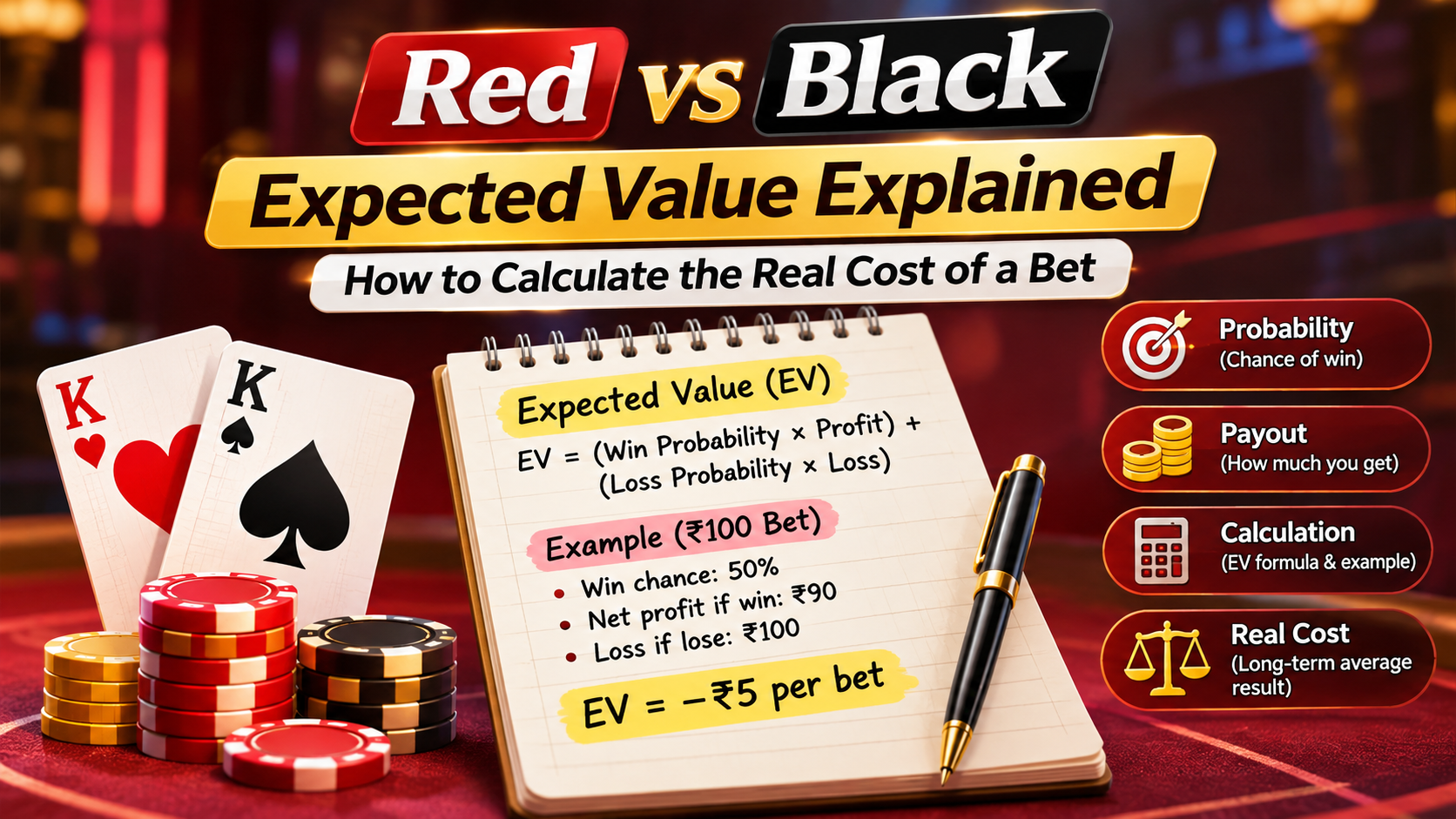
Understanding the mathematics behind a card game can help you make informed decisions instead of relying on guesses. One important concept is expected value, which explains how probability and payouts affect the average financial outcome of a bet over time.
If you are researching 3 patti red download options or learning about Red vs Black games, understanding expected value can help you evaluate the displayed rules, compare payouts, and recognise financial risks before participating. No calculation can guarantee a winning result, but basic mathematics can explain what a bet may cost in the long run.
What Is Expected Value in Red vs Black?
Expected value (EV) is the average outcome you would expect across many repetitions of the same event under identical probability and payout conditions. It considers every possible outcome, its probability, and its financial result.
In a Red vs Black game, you choose a colour and the game reveals a result. A matching colour may produce a payout, while a different result may cause you to lose your stake. The exact outcome depends on the game's rules and payout structure.
Expected value helps answer a practical question: How much might you gain or lose on average per bet under these assumptions?
How to Calculate the Expected Value of a Bet
The Expected Value Formula
Use this simple formula when a bet has two possible outcomes:
Expected Value = (Win Probability × Net Profit) + (Loss Probability × Net Loss)
Use positive numbers for profits and negative numbers for losses. Include the stake correctly so you do not mistake the total payout for your actual profit.
Example: A ₹100 Red vs Black Bet
Suppose you place a ₹100 stake under these hypothetical conditions:
- Probability of winning: 50%
- Net profit when you win: ₹90
- Loss when you lose: ₹100
The calculation becomes:
- Winning outcome: 0.50 × ₹90 = ₹45
- Losing outcome: 0.50 × (−₹100) = −₹50
- Expected value: ₹45 − ₹50 = −₹5 per bet
This example produces a negative expected value of ₹5 per bet. It does not mean you will lose exactly ₹5 on your next attempt. You could win, lose, or experience a streak of either outcome. The figure represents the mathematical average under the stated assumptions.
These numbers are illustrative, not the confirmed payout terms of My Master Teen Patti. Always check the actual game rules before calculating its expected value.
How Payout Rates Affect Your Expected Value
A game can offer nearly equal chances of red and black without providing equal financial returns.
| Hypothetical outcome | Net profit on a ₹100 winning bet | Expected value |
|---|---|---|
| Fair 50/50 payout | ₹100 | ₹0 |
| Lower winning payout | ₹90 | −₹5 |
| Higher winning payout | ₹110 | +₹5 |
The table assumes a 50% win probability, a 50% loss probability, and a full ₹100 loss on an unsuccessful bet. Actual games may use different probabilities, payout rules, or additional conditions.
A positive expected value in a hypothetical calculation does not prove that a real game offers such an opportunity. Verify the rules and probabilities before drawing conclusions.
Why Expected Value Matters Over Multiple Rounds
Expected value becomes useful when you examine repeated bets rather than one isolated result.
For example, a negative expected value of ₹5 per ₹100 bet implies an average loss of ₹500 over 100 identical bets under the same assumptions. Actual results can differ considerably because probability describes long-run averages, not guaranteed short-term outcomes.
Previous colours also cannot reliably predict the next result when rounds are independent. A long sequence of red results does not automatically make black more likely in the next round.
Avoid increasing stakes to recover losses. A betting system cannot remove an unfavourable expected value simply by changing the amount you wager.
Conclusion
Expected value offers a simple way to understand the financial mathematics behind colour-based card games. By checking probabilities, calculating net payouts, and recognising the difference between average outcomes and individual results, you can assess risk more clearly. If you explore a red black game online, review its rules, verify its payout conditions, follow applicable local laws, and set a firm spending limit. Real-money gaming carries financial risk and should never be treated as a source of income.
Frequently Asked Questions
Is expected value the same as the probability of winning?
No. Probability measures how likely an outcome is, while expected value combines probability with the financial result of every possible outcome.
Can Red vs Black have a positive expected value?
The calculation depends on the actual probabilities, payouts, and rules. Do not assume that either colour offers a mathematical advantage without verified evidence.
Does a 50% winning chance mean a fair bet?
Not necessarily. A fair bet also requires payouts that match the odds. If a win pays less than the amount lost on an unsuccessful bet, expected value may be negative.
Can expected value predict the result of the next round?
No. It estimates an average under defined conditions. It cannot tell you which colour will appear next or guarantee a profit.