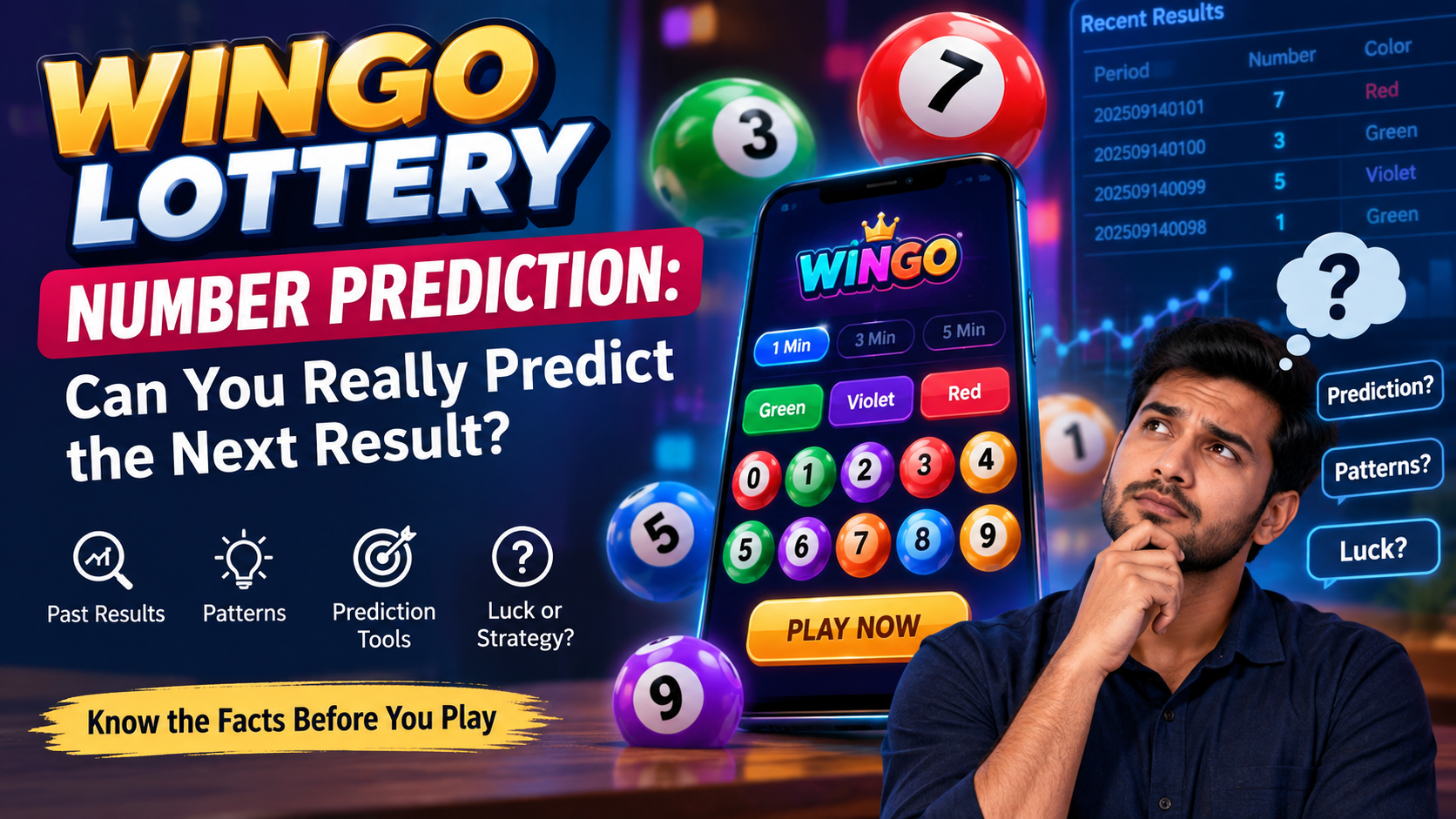
Wingo Lottery number prediction attracts many players who want to understand whether previous results, number patterns, colours, or prediction tools can help identify the next outcome. The wingo lottery game usually uses short rounds, which makes the result feel fast and exciting. However, a key question remains: Can anyone really predict the next Wingo result with certainty?
👉 Download Now and Claim a welcome bonus → mymasterteenpatti.com
The simple answer is no. A past result does not provide a guaranteed way to know the next result. Players can study previous outcomes and learn how the game works, but they should not treat a pattern, prediction chart, or so-called winning formula as a guaranteed method.
This guide explains the idea behind win go lottery prediction in simple terms and helps readers understand the difference between analysing results and actually predicting a future random outcome.
What Is Wingo Lottery Number Prediction?
Wingo Lottery number prediction refers to attempts to estimate which number may appear in an upcoming round. Depending on the particular game format, players may look at numbers, colours, odd or even outcomes, or other available options.
Some websites and apps offer prediction charts or tools that claim to identify the next result. These tools may analyse historical data, but historical data alone cannot guarantee what happens in a new round.
For example, if a particular number appeared several times recently, that does not automatically mean another number must appear next. Each new round needs to be considered on its own.
Can You Really Predict the Next Wingo Result?
No reliable method can guarantee the next Wingo Lottery result.
If the game uses a properly designed random or independently generated outcome system, previous results do not allow a player to know the next result with certainty.
Consider a simple example. Imagine a number appears five times across recent rounds. It may feel unusual, so a player might assume that the number will not appear again soon. But randomness does not work according to this assumption.
The next result can still produce the same number.
This is why players should be careful with claims such as:
- “100% accurate Wingo prediction”
- “Guaranteed winning formula”
- “Fixed number for the next round”
- “Secret prediction trick”
- “Guaranteed prediction APK”
Such claims require strong evidence. Without independently verifiable evidence, users should not consider them reliable.
How Do People Try to Predict Wingo Lottery Results?
1. Studying Previous Results
Many players check historical results and search for repeated numbers or sequences. This can help them understand the game's history, but it does not prove what the next result will be.
2. Looking for Number Patterns
Players may compare odd and even numbers, high and low numbers, or repeated sequences.
Patterns can appear naturally in random data. Finding a pattern does not automatically mean that the pattern will continue.
3. Using Prediction Charts
Some win go lottery game websites display charts that organise previous results. These charts can make historical information easier to understand.
However, a chart should remain a record of previous outcomes rather than a promise about future results.
4. Using Prediction Apps or Tools
Some third-party tools claim to predict upcoming Wingo numbers. Users should evaluate such claims carefully and avoid sharing passwords, payment information, OTPs, or other sensitive details with unverified services.
Why Past Wingo Results Cannot Guarantee the Next Result
The biggest mistake in prediction is assuming that previous outcomes control the next outcome.
Suppose the last few rounds show:
3 → 7 → 1 → 9 → 3
A player might try to find a hidden sequence. But without evidence that the game follows a predictable mathematical rule, this sequence does not reveal the next number.
Random outcomes can produce streaks, repeats, gaps, and unusual combinations.
Therefore, past performance should not be treated as proof of future results.
Is There a Wingo Lottery Winning Formula?
There is no universally proven formula that can guarantee a winning Wingo Lottery prediction.
A formula may use historical numbers, probability calculations, charts, or other statistical ideas. These methods can help someone study data, but they cannot turn an uncertain outcome into a guaranteed result.
This distinction matters because a prediction and a guarantee are not the same thing.
A prediction says:
“This outcome may happen.”
A guarantee says:
“This outcome will happen.”
For a random lottery-style game, the second claim needs extraordinary evidence.
What Should Players Check Before Using a Prediction Tool?
If you are researching a Wingo Lottery prediction tool, check the following:
Check the Source
Find out who operates the website or application. Look for clear ownership, contact information, terms, privacy information, and responsible gaming guidance.
Avoid Guaranteed Claims
Be cautious when a service promises guaranteed wins or 100% accuracy.
Protect Personal Information
Never provide sensitive account or payment information to an unknown prediction service simply because it claims to provide winning numbers.
Understand the Risk
Treat lottery-style gaming as entertainment rather than a guaranteed income source. Set a spending limit and avoid chasing losses.
A Better Way to Understand Wingo Lottery Results
Instead of asking, “Which number will definitely win next?”, a more useful question is:
“How does the game generate its results, and what can historical data actually tell me?”
This approach encourages better understanding rather than false certainty.
Players can use previous results to understand the game's history, identify how often different outcomes have appeared, and learn basic probability concepts. However, they should still recognise that these observations do not guarantee future outcomes.
This people-first approach also makes the information more useful for readers who are researching the wingo lottery game before deciding whether to play.
Final Takeaway
Wingo Lottery number prediction can help players explore historical data, but it cannot guarantee the next result. The wingo lottery game may produce patterns that look meaningful, yet those patterns do not automatically provide a reliable prediction method.
For anyone researching win go lottery or win go lottery game information, the safest approach is to understand how the game works, question guaranteed-win claims, protect personal information, and treat gaming as entertainment rather than a source of guaranteed income.
Sources and Editorial Basis
This article follows Google Search guidance that recommends original, helpful, reliable and people-first content, with clear expertise and trustworthy sourcing. Google also recommends creating useful content for both traditional search and generative AI experiences rather than producing content primarily to manipulate rankings.
Why this article is written: The purpose is to answer a common reader question—whether Wingo Lottery results can actually be predicted—without presenting uncertain predictions as guaranteed facts. This improves transparency and gives readers practical information before they make gaming decisions.
Frequently Asked Questions
Can Wingo Lottery numbers be predicted accurately?
No method can reliably guarantee the next Wingo Lottery number. Prediction tools may analyse previous results, but analysis does not guarantee a future outcome.
Is there a 100% accurate Wingo prediction trick?
There is no independently verified 100% accurate prediction trick. Be cautious about websites or apps that make guaranteed-winning claims.
Can previous Wingo results predict the next number?
Previous results can provide historical information, but they cannot guarantee the next number. A new round may produce a different outcome regardless of previous results.
Does a Wingo prediction app guarantee winning?
No. A prediction app cannot guarantee a winning result unless it has extraordinary, independently verified evidence that demonstrates how it can accurately determine future outcomes.
Is Wingo Lottery based on luck or skill?
The answer depends on the exact game and how its results are generated. If the game uses random outcome generation, players cannot use skill or historical patterns to guarantee the next result.
Should I trust Wingo Lottery prediction websites?
Research the website before using it. Avoid services that make unrealistic guarantees, request unnecessary sensitive information, or provide no clear explanation of their claims.
Can AI predict the next Wingo Lottery result?
AI can analyse historical data and identify statistical patterns, but analysis does not mean certainty. AI should not be presented as a tool that can guarantee a future random result.